
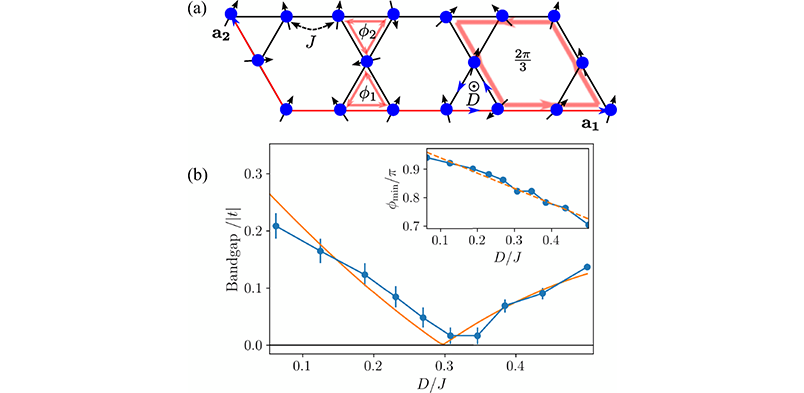
Abstract- Recent experiments on the Kagome spin liquid candidate material YCu3(OH)6Br2[Br1−𝑦(OH)𝑦] suggest the presence of Dirac fermionic spinons near the magnetization plateau at 1/9. Theories suggest that the spinons are charge neutral spin-1/2 excitations, in a 2𝜋/3 flux, which triples the unit cell. Generally a gap is expected, and there is no symmetry protection for the Dirac nodes in this system. The question arises as to what causes the nodes and stabilizes them. In this work, we propose a node-creation and node-pinning mechanism driven by Dzyaloshinskii-Moriya (DM) interactions. Employing Gutzwiller-projected variational Monte Carlo calculations, we demonstrate that DM interactions induce a band closing phase transition in the spinon spectrum. There is a change in the Chern number when the bands are inverted. Together with the DM-generated internal gauge flux, the coupling to the spinon orbital magnetization counteracts the band reopening. This interplay energetically pins the Dirac nodes over a range of parameters, resulting in a pinning mechanism distinct from the usual one from symmetry protection.
