
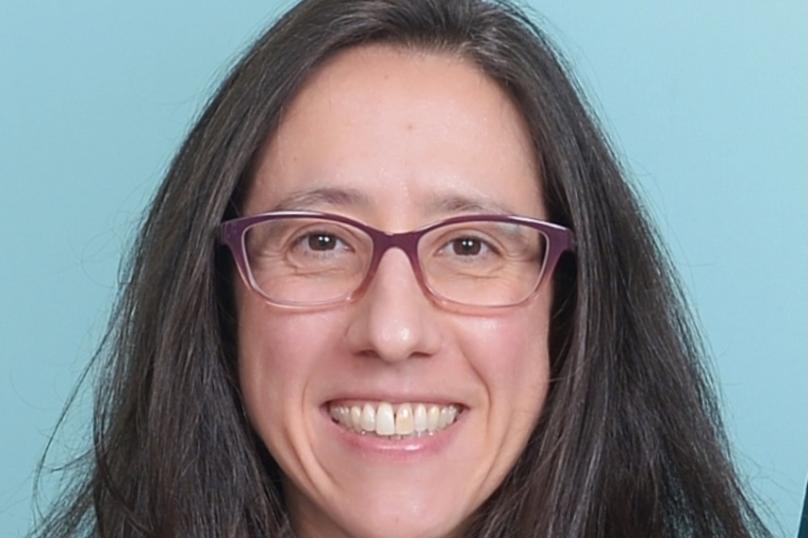
Laura Mehrmanesh describes herself as an interdisciplinary engineer. She loves
to solve problems by thinking across many different fields. Her PhD in electrical
sciences and computer engineering, for example, focused on the exploration of
nanotubes and their interactions with biomolecules.
So Mehrmanesh is excited about her new position at the Materials Research
Laboratory (MRL) as an Industry Collaboration Strategist, where she’ll match
MIT’s wide range of materials-related academic research with industry needs and
opportunities. The goal is to “help both sides make connections they weren’t
aware of and create synergistic collaborations,” she says.
Mehrmanesh, who has a BA in physics from Bryn Mawr College and a PhD from
Brown University, has a track record of successfully facilitating the
commercialization of new technologies. She’s done just that across fields
including biology, chemistry, nanomaterials, and power systems.
One of her favorite projects, sponsored by the Department of Energy ARPA-E,
was at the University of California. It involved the development of a power grid
‘micro-synchrophasor’ sensor, a device capable of making synchronized voltage
and current measurements precise enough for the electricity distribution system.
“Existing transmission system synchrophasors were becoming increasingly
insufficient for analyzing two-way power flows from residential solar and
cascading blackouts originating on the distribution system,” Mehrmanesh says.
She was the principal investigator’s project manager, leading the field
deployments of the new sensors and helping to transition the university’s
academic findings and tools into marketable products. “It was a very large,
complex project with some 100-plus milestones over four and a half years,” she
remembers. “I focused on the big picture, managing relationships between the
university, government, and industry.”
Earlier in her career, she was a technology scout for Textron, a major defense
contractor. There, she was tasked with uncovering early-stage technologies that
could advance Textron products. “I focused on finding startups or universities
working on nanomaterials that, for example, Textron could use in its next-
generation helicopters, planes, and surveillance systems.”
From there, she’d offer seed grants from Textron to further develop a given
technology. “The idea was to build a prototype or otherwise demonstrate the
technology’s potential for functions and features my company needed.”
At the MRL, Mehrmanesh will analyze MIT’s current materials science research
and identify problems facing companies that MRL could address. To that end,
she’ll work closely with MRL’s new Pilot Centers to align MIT studies of, say, light-
activated polymers with industry challenges and external market trends.
She concludes, “I would like to help MRL by giving its Pilot Center researchers
unexpected cross-disciplinary examples of how their technology could be used,
and I’d like to help industry by bringing their attention to potential solutions
already in progress. That’s what I think is fun!”