
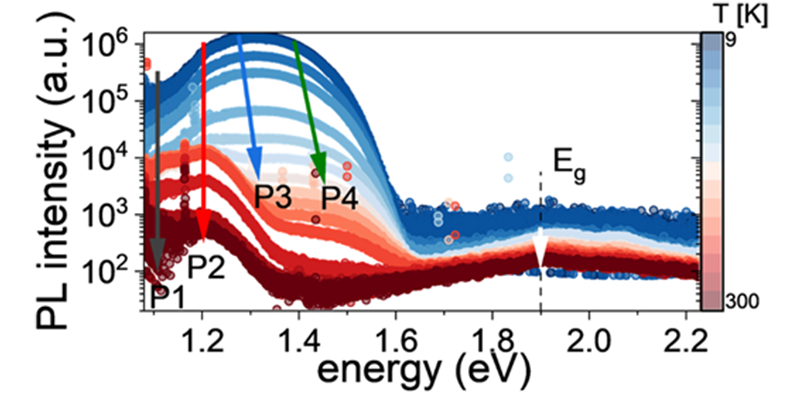
Abstract- The chalcogenide perovskite BaZrS3 has recently emerged as a promising material for photovoltaic energy conversion, composed of earth-abundant elements. Unlike its halide counterpart, BaZrS3 has not yet demonstrated strong photoluminescence (PL). The excitation-intensity and temperature dependence of radiative emission in thin films of chalcogenide perovskite BaZrS3 were studied using PL spectroscopy. Oxide precursors with compositional gradients (0.4 < [Ba]/([Ba] + [Zr]) < 0.6) were prepared with pulsed laser deposition followed by sulfurization in a tube furnace at different H2S in Ar concentrations, as well as temperatures ranging from 900 °C to 1000 °C. As the radiative emission at room temperature was not detectable, low temperature measurements were performed, revealing a high defect density both of shallow and deep levels, related to both free-bound as well as donor–acceptor transitions. Broad emissions were detected near 1.11 eV, 1.2 eV, 1.33 eV and 1.42 eV. We compared theoretical defect level calculations from literature with the detected emissions. The dependence of some defects on sulfur partial pressure during the sample preparation could be corroborated by comparing the transitions of libraries prepared at different H2S concentrations.
 |
Rafael Jaramillo
|