
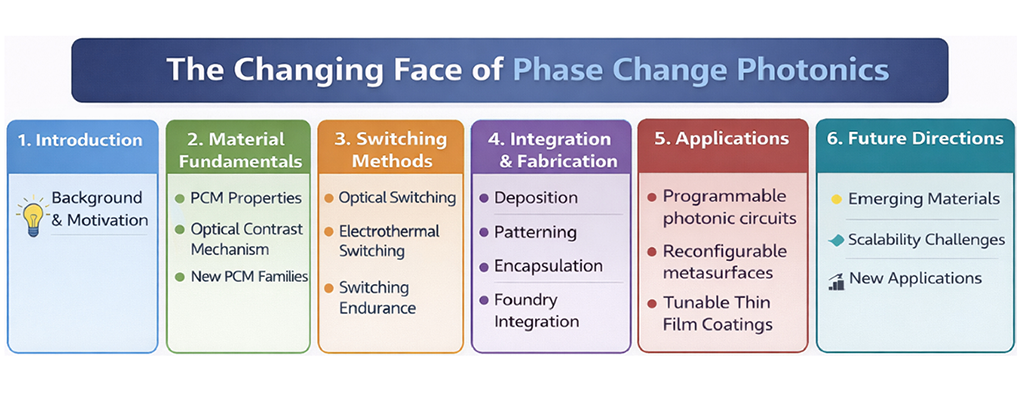
Abstract— Reconfigurable photonic devices capable of dynamically tuning their optical characteristics to adapt to different application demands on-the-fly have become a focus of intensive research and development efforts in recent years. Compared to classical tuning mechanisms relying on thermo-optic or electro-optic effects, the giant nonvolatile refractive index contrast provided by phase change materials (PCMs) upon solid-state structural transitions enables reconfigurable devices with an unprecedented compact footprint, zero static power consumption, and superior optical performance. These unique features have catalyzed phase change photonics, an emerging field characterized by a rapidly evolving research landscape. This review presents a deep dive into this dynamic field, spanning fundamental material design principles and processing techniques to PCM integration into various state-of-the-art device platforms and industry-standard foundry manufacturing processes. We also identify challenges that PCM photonics need to address and point out directions where exciting innovations will likely come to fruition in the near future.
 |
Juejun Hu
|