
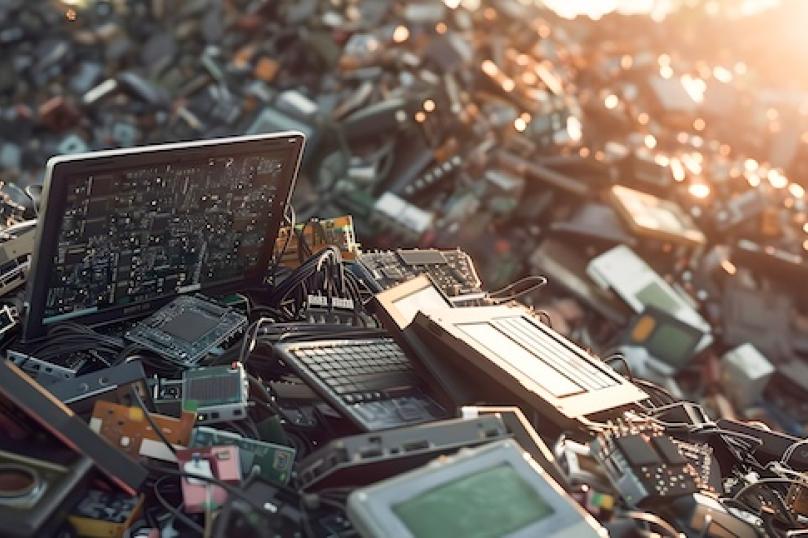
MIT researchers have developed a new, efficient way to recycle gallium, indium, and potentially other critical metals key to modern electronics from e-waste like discarded computer screens. The process could also be applied to waste streams from companies that create products containing these metals.
“Once optimized, our process could recover 1.2 kilograms of these metals per day,” says Antoine Allanore, a professor of metallurgy in the Department of Materials Science and Engineering. He notes, however, that this can only happen if a great deal of e-waste is recycled, and currently there are no large-scale efforts to that end. The recycling rate for gallium and indium from e-waste is currently close to 0 percent.
The work is important because gallium and indium are listed as critical metals by the United States and the European Union. That’s because they are only produced as byproducts from the mining of other metals like zinc and aluminum, and those mining operations, in turn, are dominated by only a few countries, including China.
For many reasons, it doesn’t make economic sense to open new zinc and aluminum mines solely for these byproducts, says Allanore. “Can we instead recycle and recover these two critical metals from e-waste?”
He and colleagues have developed a multi-step process to do just that. These steps range from first physically removing LED chips and other sources of the metals from the e-waste, to exposing them to high temperatures to liberate chemical components. Many of these steps are familiar to industry.
Key to the new work is a sulfidation step, in which sulfur gas selectively reacts with gallium or indium to create gallium-sulfur or indium-sulfur compounds, leaving behind the aluminum oxide substrate the metals were originally bound to. “That’s the novelty of our approach. We’ve been working on sulfidation for the last seven years,” says Allanore. In 2021 he and a colleague reported the general technique in the journal Nature.
In mid-November Allanore presented a paper on the current work at Extraction 2025, a conference held in Arizona. Another, complementary paper appeared earlier this year in the Journal of Metals. Allanore’s coauthors on both papers are Ethan Benderly-Kremen, MIT PhD 2025, and Katrin Daehn, a research scientist at the Materials Research Laboratory (MRL). Allanore is also affiliated with the MRL.
This work was supported by the US Department of Defense through the Defense Advanced Research Projects Age