
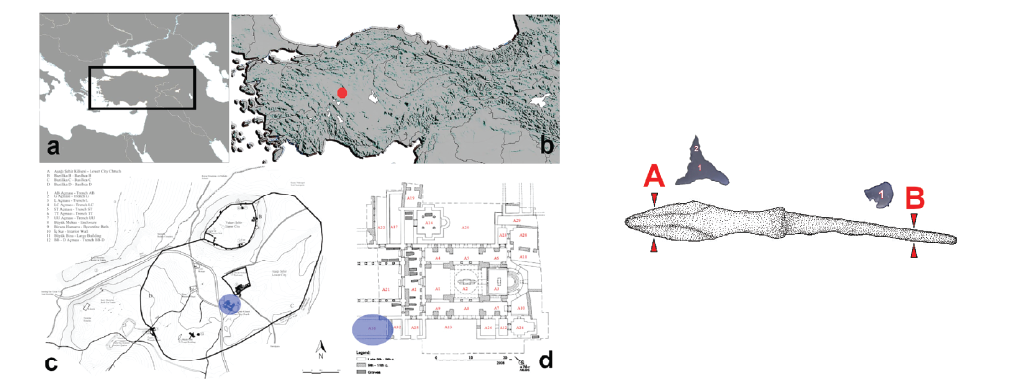
Abstract- An arrowhead that was recovered during the excavations of the lower city church of Byzantine Stronghold Amorium in central Anatolia has been subjected to archaeometric analysis. Coins discovered in the same context date the arrowhead to the Middle Byzantine period (ninth–tenth century CE). It is a three-bladed arrowhead with a needle-type tang. Metallography (OM, SEM), SEM–EDS and EBSD techniques were used to examine samples taken from the head and the tang sections of the arrowhead. The arrowhead was determined to be made of manganese-alloyed crucible steel (0.4–1% Mn), shaped through warm forging cycles and selectively quenched and tempered to enhance its mechanical properties. The hardened head, likely designed for armor penetration, along with the potential watered surface pattern (frind), suggests that the arrowhead functioned both as a weapon and a symbol of prestige. Historical sources and archaeometallurgical evidence link the arrowhead to mounted Turkic archers in the Abbasid army during the 838 CE Sack of Amorium. This study of the arrowhead revealed it to be the earliest crucible steel fnd and the only example of such an object manufactured from crucible steel discovered in medieval Anatolian excavations
 |
Cem Tasan |