
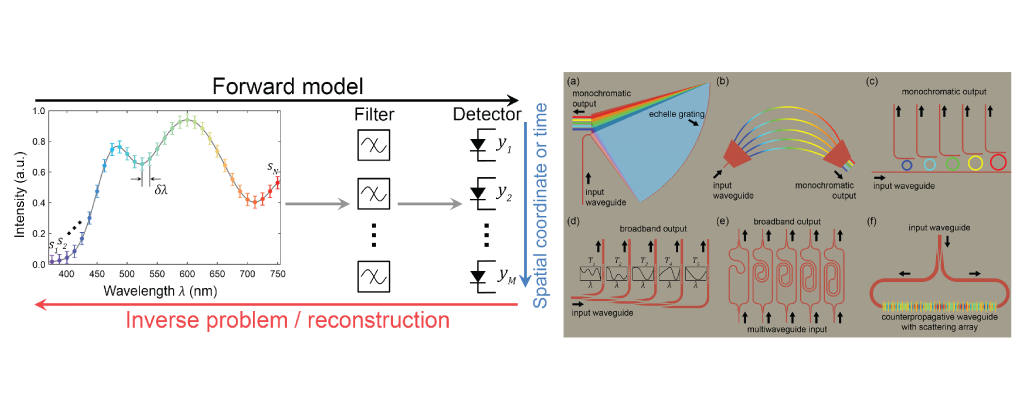
Abstract— Integrated photonics, where optical components are fabricated on a chip-scale platform leveraging standard microfabrication technologies, has transformed telecommunications and data communications, quantum optics, and molecular sensing. Optical spectrometry is yet another field that integrated photonics is poised to revolutionize. Unlike traditional bulky, costly benchtop spectrometers, integrated photonics promises miniaturized, rugged, and low-cost spectrometer-on-a-chip modules with broad application prospects ranging from communications to medical imaging. In this review, we survey the various designs of integrated photonic spectrometers through the lens of their underlying operating principles, aiming to reveal quantitative performance scaling laws that transcend specific implementations. This approach enables a general, physically grounded comparison of spectrometer capabilities without being bogged down by device-level details. We further provide guidance on selecting appropriate spectrometer architectures for different applications, taking into account not only their reported advantages but also the practical limitations and implementation challenges.
Introduction— Optical spectrum analysis is the cornerstone of spectroscopic sensing, optical network performance monitoring, hyperspectral imaging, astronomical spectroscopy, and spectral domain optical coherence tomography (SD-OCT). Such analysis traditionally involves bulky and costly benchtop instruments only found in dedicated laboratories. Emerging market opportunities ranging from point-of-care diagnostics to sensor network deployment are now increasingly demanding spectrometers with reduced size, weight, power, and cost (SWaP-C) metrics.[1–4]
Photonic integrated circuits (PICs),[5–9] the optical analog of electronic integrated circuits, offer a promising route towards miniaturized spectrometers. Compared to conventional spectrometers based on bulk optics, PIC technologies promise several critical performance advantages in addition to their apparent SWaP-C benefits. Photonic integration defines devices on-chip with lithographic precision, thereby largely obviating the need for stringent alignment between discrete optical elements and dramatically boosting the ruggedness of spectrometer modules. The advent of ultralow-loss optical waveguides[10] allows long optical paths to be folded onto a small chip, enabling spectrometers with exceptional spectral resolution. PICs also provide access to ultra-compact, high-speed optical switches to route light between different paths through thermo-optic (TO), electro-optic (EO), or micro-electromechanical systems (MEMS), an essential feature for time-domain modulated spectrometers.[11] Finally, PICs facilitate interfacing with other chip-scale micro-modules such as electronics for signal processing and microfluidics for analyte handling, potentially leading to full system-in-a-package solutions.
In this review, we aim to provide a comprehensive survey of the state-of-the-art in PIC-based spectrometers. The review is organized as follows. We will start with describing a generic model of optical spectrometers, followed by an overview of the spectrum reconstruction methods. Next, we will proceed to review different variants of PIC-based spectrometer designs and assess their relative merits. Given the focus on PIC technologies, we limit the scope of this review to waveguide-based spectrometers, and we direct interested readers to other reviews that cover non-PIC spectrometers (which may still leverage chip-scale microsystem technologies).[12–17] Beachhead markets where PIC-based spectrometers are likely to make a disruptive impact are then evaluated.
 |
Juejun Hu
|