
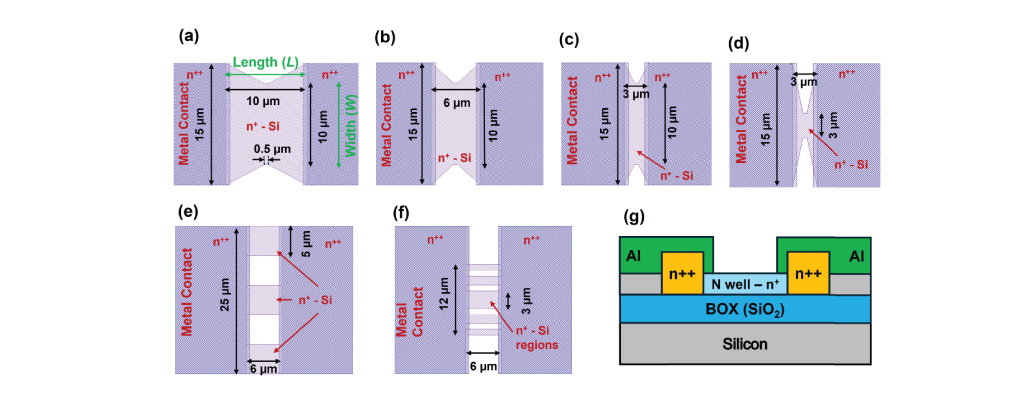
The growing interest in optical phase change materials (PCMs) has spurred the development of programmable photonics systems with zero-static power. Their optical properties make them well-suited for nonvolatile retention and reversible phase switching. PCMs can be switched using optical pulses or integrated microheaters. Microheaters provide Joule heating to indirectly induce the phase change. This mechanism offers the most promising route to achieving scalability through CMOS integration and reliable multilevel modulation. However, optimizing the design and modulation of microheater devices has become challenging due to the complex electrothermal dynamics, which require high temporal and spatial resolution techniques for accurate assessment. This article presents an electrothermal co-design of silicon-doped microheaters through advanced thermal characterization, which can reveal temperature distributions, on the submicrosecond scale, not readily obtainable through computational methods. We evaluate the geometrical and electrical parameters dependence on the transient thermal transport to maximize the hotspot temperature and quenching rates, as well as the impact of the pulsewidth on the multilevel response and energy consumption. High resolution transient thermoreflectance imaging (TTI) was used to measure and evaluate the temperature distribution under pulsed biasing (0.2– 10 μ s). Reduced doped region lengths ( <6 μ m) enable higher current densities to maximize the temperature and quenching rates. Additionally, shorter pulsewidths ( <1 μ s) enable well-defined multilevel temperature profile responses and ≈13 times reduction in energy consumption.
 |
Juejun Hu
|