
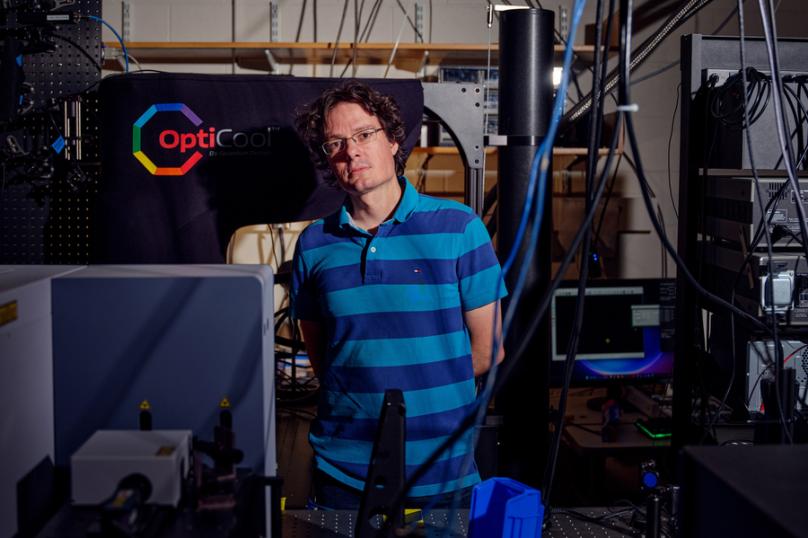
MIT Associate Professor of Physics Riccardo Comin has been selected as 2025 Experimental Physics Investigator by the Gordon and Betty Moore Foundation.
The prestigious Experimental Physics Investigators (EPI) Initiative recognizes mid-career scientists advancing the frontiers of experimental physics. Each award provides $1.3 million over five years to accelerate breakthroughs and strengthen the experimental physics community. Comin, who is also affiliated with the Materials Research Laboratory, joins 21 other researchers in the 2025 EPI cohort of mid-career researchers pushing the boundaries of experimental physics.
New routes to multiferroics
Comin investigates magnetoelectric multiferroics by engineering interfaces between two-dimensional materials and three-dimensional oxide thin films. His research aims to overcome longstanding limitations in spin-charge coupling by moving beyond epitaxial constraints, enabling new interfacial phases and coupling mechanisms. In these systems, Comin’s team explores the coexistence and proximity of magnetic and ferroelectric order, with a focus on achieving strong magnetoelectric coupling. This approach opens new pathways for designing tunable multiferroic systems unconstrained by traditional synthesis methods.
Comin’s research expands the frontier of multiferroics, in which ferroelectricity and ferromagnetism exist in a single material, by demonstrating stacking-controlled magnetoelectric coupling at 2D–3D interfaces. This approach enables exploration of fundamental physics in a versatile materials platform and opens new possibilities for spintronics, sensing, and data storage. By removing constraints of epitaxial growth, Comin’s work lays the foundation for microelectronic and spintronic devices with novel functionalities driven by interfacial control of spin and polarization.
Comin’s project, Interfacial MAGnetoElectrics (I-MAGinE), aims to study a new class of artificial magnetoelectric multiferroics at the interfaces between ferroic materials from 2D van der Waals systems and 3D oxide thin films. The team aims to identify and understand novel magnetoelectric effects to demonstrate the viability of interfacial magnetoelectric coupling. This research could lead to significant contributions in multiferroics, and could pave the way for innovative, energy-efficient storage devices.
The few known bulk multiferroics with strong magnetoelectric coupling generally rely on inversion symmetry-breaking spin arrangements, which only emerge at low temperatures, limiting practical applications. While interfacial magnetoelectric multiferroics offer an alternative, achieving efficient spin-charge coupling often requires stringent conditions like epitaxial growth and lattice matching, which limits material combinations. This research proposes to overcome these limitations by using non-epitaxial interfaces of 2D van der Waals materials and 3D oxide thin films.
Unique features of this approach include leveraging the versatility of 2D ferroics for seamless transfer onto any substrate, eliminating lattice matching requirements, and exploring new classes of interfacial magnetoelectric effects unconstrained by traditional thin-film synthesis limitations.