
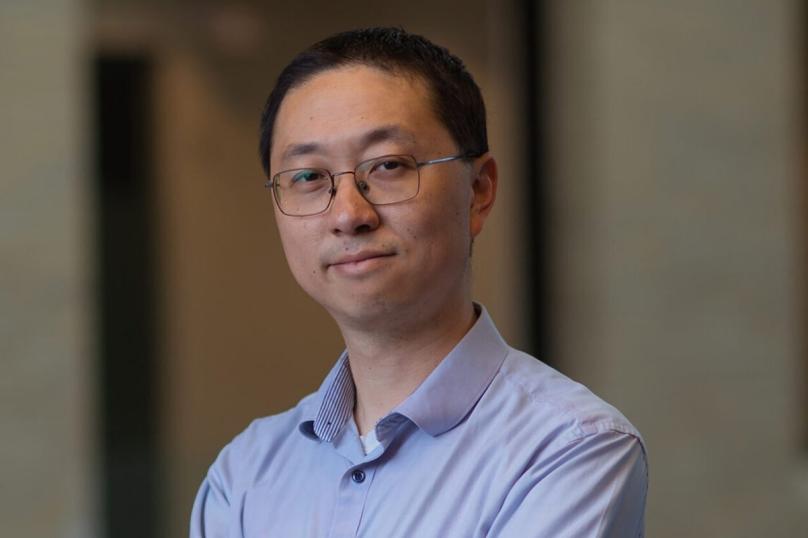
One of the research topics in Juejun (JJ) Hu’s laboratory is metasurfaces, flat optical devices patterned with nanoscale structures that “when put together in a smart way can actually manipulate light propagation,” says the professor in the Department of Materials Science and Engineering.
Already he and colleagues have used the technology to create a completely flat fisheye lens for the production of crisp panoramic images. “Conventionally, you need something like eight to 12 individual curved glass lenses to capture an image across 180 degrees. We can do the same thing with a thin, flat layer of metasurface,” says Hu, who is also affiliated with MIT’s Materials Research Laboratory.
A year later his team reported creating a tunable metasurface, or one whose optical properties can be reconfigured in response to a heat-induced transition in a class of alloys called phase-change materials. Potential applications include adaptive optics and programmable photonic circuits for AI computing. Key to that work: the discovery of a new material.
The metasurface technology is important because it is leading to smaller, lighter, and potentially cheaper optical devices that could impact everything from biomedical imaging to high-speed communications.
Indeed, for Hu, one of the best parts of his work is translating basic research into practical applications. To that end, he’s started several companies, including 2Pi Inc., whose products include the new fisheye lens. “It’s been really exciting to see how the company has grown. We started four years ago and we’re now shipping products to industry,” Hu says.
Hu is also the principal investigator for a new program that, he says, “aims to bring the optical metasurface technology to the next level by integrating it with CMOS electronics and optoelectronics using standard manufacturing processes.” The goal is to incorporate the technology into a single wafer-scale platform.
The Wafer-scale Integrated Sensing Devices based on Optoelectronic Metasurfaces (WISDOM) program includes nine other researchers from MIT, Nanyang Technological University, the National University of Singapore, Stanford University, and the University of Illinois Urbana-Champaign. WISDOM is funded by the Singapore-MIT Alliance.
Next month Hu will also describe how his work can be applied to extreme conditions at a Materials Day Symposium sponsored by the MRL. Designing the Future of Extreme Materials, which will feature nine other speakers, will be held October 14 at MIT. For more information and to register go to the following link.