
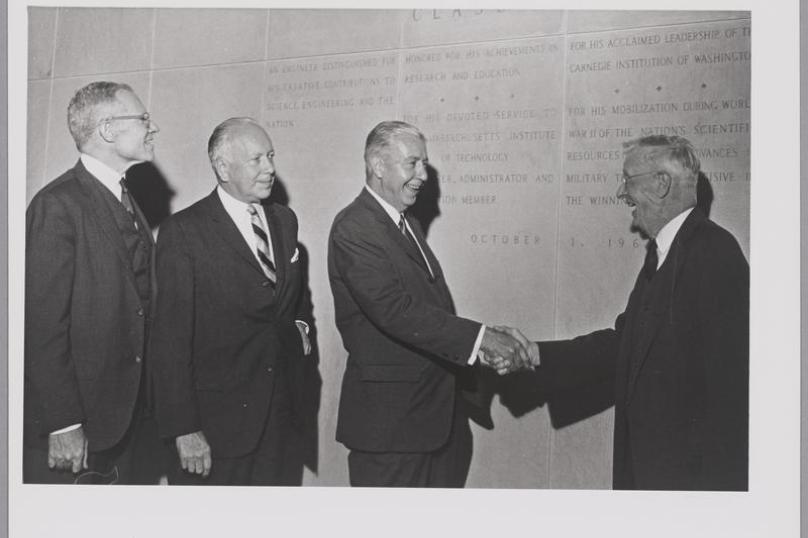
In 1965, approximately 700 scientists, engineers, and guests gathered to celebrate the inauguration of a significant new structure at MIT. This structure was dedicated to both the exploration of materials and to one of MIT’s—and the nation’s—most esteemed and honored scientists of the time.
Sixty years later, the Vannevar Bush Building, affectionately known as Building 13, continues to serve as a hub for researchers engaged in studying the structure, properties, and applications of both old and new materials. Today’s research encompasses a diverse range of topics, from developing eco-friendly steel production methods to characterizing recently discovered quantum materials.
In October 1965, a remarkable event took place when 12 MIT scientists and engineers, including a future Nobel laureate and MIT’s inaugural Institute Professor, presented their groundbreaking research at a symposium that was an integral part of the building’s dedication activities. Among the esteemed speakers was MIT Professor of Physics Clifford G. Shull, who delivered a captivating lecture on recent neutron diffraction studies. Shull’s pioneering work in neutron diffraction, a technique that unravels the intricate arrangement of atoms within a material, would later earn him the prestigious 1994 Nobel Prize.
During the dedication ceremony held in October 1965, MIT President James R. Killian eloquently articulated the profound significance of naming the building after Vannevar Bush. He explained that it was an apt choice to honor Bush’s contributions to materials research, recognizing his pivotal role in shaping the field and inspiring generations of scientists.
According to an MIT News article published at the time, President Killian highlighted Dr. Bush’s career as an engineer, inventor, and administrator of wartime science and technology for President Roosevelt. He emphasized the continuity between basic and applied research, showcasing Dr. Bush’s accomplishments that exemplified both the pursuit of scientific knowledge for its own sake and the creative application of that knowledge to create practical and useful things for the real world.
This same holistic approach to research, particularly in materials, is the foundation of the MIT Center for Materials Science and Engineering (CMSE), the building for which the MRL was constructed.
Formed in 2017 from the merger of MPC and CMSE, MRL extends MIT’s leadership in materials science. As steward of Building 13, MRL will host “Designing the Future of Extreme Materials” next month—two keynotes and eight MIT faculty talks—an event focused on the field’s future. In the months that follow, MRL will connect historic breakthroughs from Building 13 to today’s advances, carrying forward the legacy of Vannevar Bush.